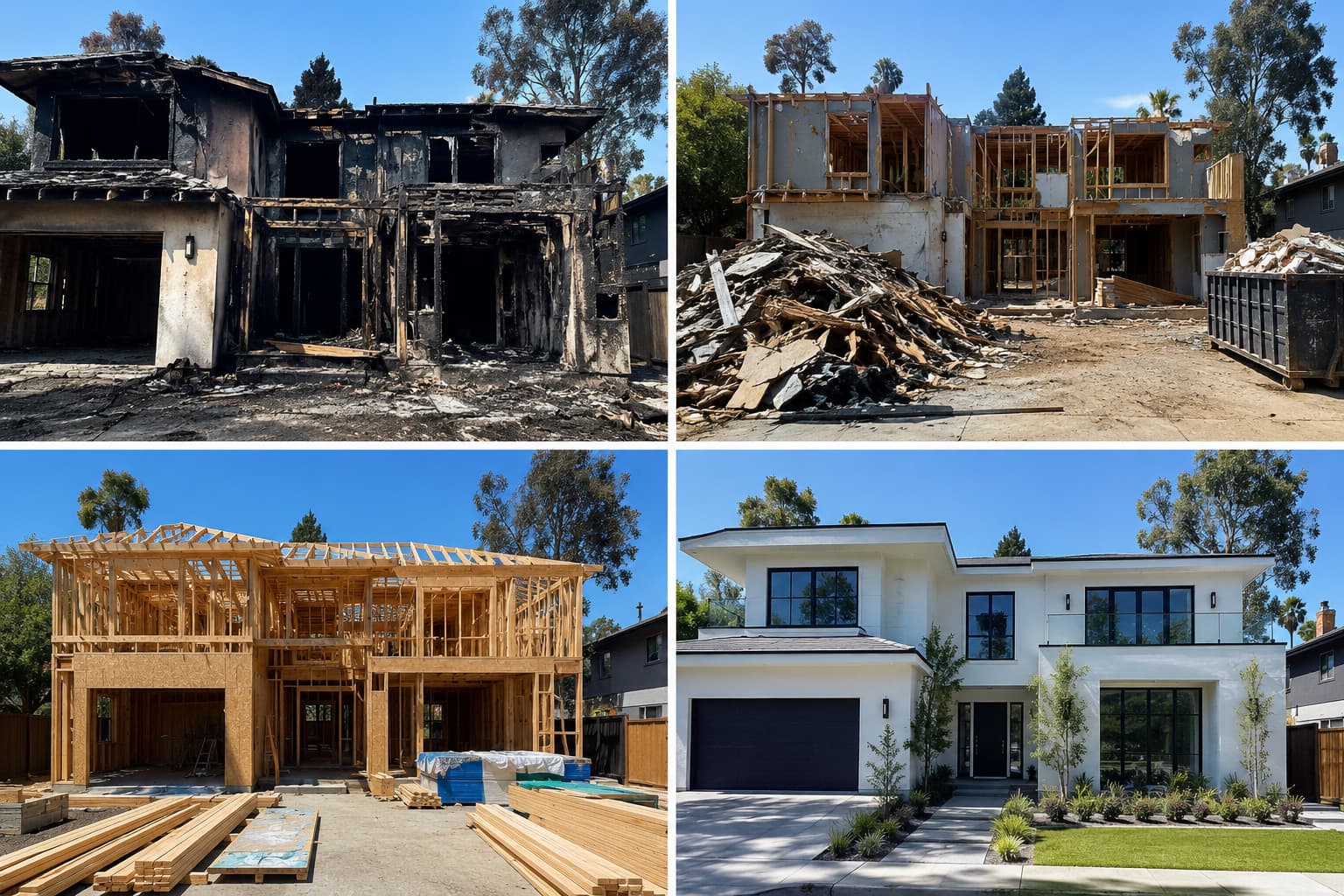
What Happened in Malibu
The City of Malibu sits on a narrow 27-mile coastal strip between the Pacific Ocean and the Santa Monica Mountains — a landscape whose beauty and geology also make it one of the most fire-exposed communities in California. Within a single year, Malibu was hit by two catastrophic wildfires that destroyed homes, businesses, and a meaningful share of the city itself.
The Franklin Fire ignited on December 9, 2024 in Malibu Canyon about three miles north of Pacific Coast Highway. CAL FIRE and the City of Malibu confirmed 4,037 acres burned, 20 structures destroyed (9 single-family homes and 11 outbuildings), and 28 structures damaged (14 SFD, 1 multi-family, 7 commercial, 5 outbuildings). Containment reached 100% on December 18, 2024 (City of Malibu, malibucity.org/FranklinFire).
The Palisades Fire ignited on January 7, 2025 and devastated Malibu within 24 hours. According to the City of Malibu official Palisades Fire incident page, 720 structures were destroyed inside Malibu city limits, of which 322 were coastal homes — not the 532 homes figure that circulates in some search summaries, which is in fact a permit count, not a structure-destruction count. Community Development Director Yolanda Bundy reported that approximately 700 homes and roughly 10% of all structures in the City of Malibu were destroyed, and that one-third of the city was wiped out within 24 hours (City of Malibu legal complaint, February 2026). Named Malibu losses included Moonshadows, The Reel Inn, Cholada Thai, Rosenthal Wine Bar & Patio, and the Malibu Village mobile home park, with at least 12 deaths across the broader incident (six of them in Malibu) and approximately 1,400 residents displaced (City of Malibu complaint, 2026-02-17; malibucity.org, 2025-09-27).
The fire hit Big Rock, La Costa, Carbon Beach, Las Flores Canyon, Carbon Canyon, Rambla Pacifico, and Topanga Beach hardest — primarily the corridor north of PCH. According to a 2025 economic analysis cited in the City complaint, more than 1,500 structures were damaged or destroyed along Malibu eastern edge, and nearly half of all jobs in the city were located at properties completely destroyed by the fire.
Where the Malibu Rebuild Stands Now
Eighteen months after the Palisades Fire and over 19 months after the Franklin Fire, the City of Malibu is in active rebuild mode — but the pace is slower than the City of Los Angeles or unincorporated Altadena. The bottleneck is not debris (that is done) or utilities (those are restored). The bottleneck is the regulatory pathway that any given property has to travel.
Per the City of Malibu June 29, 2026 newsflash (data as of June 26, 2026): 269 property owners have started rebuilding, 342 planning approvals have been granted, 900 building permits have been issued across debris-removal, repair, damaged-structure, and rebuild work, and 77 rebuilding permits have been issued specifically for new construction. Since May 2026 the city added ten more Planning approvals and six more rebuild permits, and the first Carbon Beach home is nearing completion of framing (City of Malibu, 2026-06-29).
For perspective, live data pulled from the City of Malibu permit system on July 16, 2026 shows that 7.5 years after the 2018 Woolsey Fire, only 228 of 375 tracked rebuild projects are complete — a 60.8% completion rate. Three years post-Woolsey (November 2021), only 55 Malibu homes had been rebuilt (malibutimes.com). Of the Woolsey rebuilders who finished, roughly 85% stayed within like-for-like or like-for-like +10% — strong evidence that the limited-bulk pathway is what most Malibu homeowners actually use.
The Malibu Permit Pathway, Step by Step
Malibu is a Coastal Zone city, and most of the rebuild rules reflect that. The pathway you choose determines whether your project finishes this year or sometime in 2028 — a difference measured in years, not weeks.
Two Permits, Two Timelines
- Option 1 — Planning Verification: $200, ~one week. For straightforward like-for-like rebuilds where every zoning criterion is met by the prior structure. Path is administrative, no public hearing.
- Option 1 — Administrative or Site Plan Review: $1,590–$3,499, 3–6 months. For like-for-like rebuilds that need a closer look at site plan review (e.g., height over 18 feet on a non-beachfront lot).
- Option 2 — Coastal Development Permit (CDP): $11,579 or more, 12–24 months. Requires public noticing, a Planning Commission hearing, and is appealable to the City Council and the California Coastal Commission.
Those figures are from maliburebuilds.org (City of Malibu official rebuild portal, 2026). A Malibu rebuild can swing a full year or more on the pathway you qualify for — which is exactly why a design-build team that knows ZI-15 Zoning Interpretation 15 (October 2025) is worth its weight.
Ordinance No. 524 / 524U — Disaster Rebuild Ordinance
Adopted in March 2025, the City of Malibu Disaster Rebuild Ordinance (No. 524, later updated as 524U) governs Palisades, Franklin, and Broad fire rebuilds. The companion Local Coastal Program amendment was certified by the California Coastal Commission on April 10, 2025. The ordinance works alongside MMC §17.60.020(C) and LIP §13.4.6 to give qualifying rebuilders a streamlined path.
The +10% Bulk Rule: Replacement structures may not exceed 110% of the previous structure volume. Critically, in Malibu the constraint is bulk (volume) — not just square footage or height. The extra 10% may be allocated to height or to square footage, but not to both (Zoning Interpretation 15, Issue 1, 2025-10-15).
The 50%-Footprint Location Rule: A replacement structure must be sited substantially in the same location — defined as within 50% of the previous footprint and envelope. Relocation beyond that threshold requires either a De Minimis Waiver under LIP §13.4.11 or a full Coastal Development Permit (ZI-15, Issue 2).
CDP Exemption: You do not need a CDP if your rebuild (1) has the same use, (2) stays within 10% over prior floor area, height, and bulk, and (3) sits substantially in the same location (ZI-15, Issue 7). Replacement structures are also excluded from the LCP New Development definition — so there are no City-imposed sea-level-rise requirements, and beachfront height is set by FEMA flood-plain regulations rather than coastal view analysis.
Fee Waiver — Critical Deadlines
The City of Malibu waives City planning and building permit fees for like-for-like and like-for-like +10% rebuilds — including planning approvals, building permits, temporary housing, OWTS upgrades, required infrastructure (seawalls), temporary water tanks and suppression systems, accessory structures, and hardscape/landscape. Only City fees are covered; other agency fees are not. Eligibility is limited to single-family homes and owner-occupied duplexes; commercial properties are excluded. The home must have been the primary residence as of the Broad Fire (November 6, 2024), Franklin Fire (December 9, 2024), or Palisades Fire (January 7, 2025).
The deadlines are hard: fee waiver applications are due June 30, 2028 at 4:00 PM; planning applications must be deemed complete by June 30, 2028; and all building permits must be obtained by December 30, 2030. If the property is sold before a Certificate of Occupancy is issued, all waived fees must be reimbursed to the City within 90 days (maliburebuilds.org/feewaiver). These windows will not be extended.
Executive Order N-4-25 — And What It Does Not Cover
Governor Newsom EO N-4-25 (signed January 12, 2025) suspends CEQA review and the California Coastal Act permitting requirement for reconstruction of substantially damaged or destroyed properties, but only when the rebuild is in substantially the same location and stays within 110% of prior footprint and height. The order was reaffirmed on January 6, 2026.
Critical Malibu-specific limitation: EO N-4-25 covers the Palisades, Eaton, Hurst, Lidia, Sunset, and Woodley Fires — it does NOT cover the Franklin Fire (December 2024) or the Broad Fire (November 2024). Franklin and Broad rebuilds receive Ordinance 524 relief, but they do not get the state Coastal Act suspension. This is a distinction most competitor content misses, and it directly affects how the design and entitlement package should be assembled. Also worth noting: the 30-day permitting language in EO N-4-25 is a goal directed to HCD, not a binding mandate on local agencies, and local zoning and approvals still apply.
The Malibu Rebuild Center
The City of Malibu opened the Rebuild Center in March 2025, with Community Development Director Yolanda Bundy stationed there daily. It is the single best starting point for any Malibu fire victim — zone captains, added planning staff, standardized architectural templates, and access to the Archistar AI plan-checking tool all live there.
Malibu Rebuild Center: (310) 456-2489 ext. 400. It has held 2,018 appointments since opening, averaging roughly 45 per week (City of Malibu, 2026-01-26 and 2026-06-29). Goldenline meets homeowners there to align on jurisdiction, scope, and pathway before any drawings are started.
Building Codes a Malibu Rebuild Must Meet
Every Malibu rebuild must satisfy the current California Building Code — and every Malibu lot sits inside a Very High Fire Hazard Severity Zone, which means the wildfire-specific exterior provisions apply in full. The codes have changed since most of the original homes were built.
CWUIC Replaces Chapter 7A
As of January 1, 2026, the wildfire construction provisions live in the new California Wildland-Urban Interface Code (CWUIC, Title 24 Part 7) rather than in CBC Chapter 7A. Substantive standards sit in CWUIC Chapter 5. Key mandates for every Malibu rebuild:
- Class A fire-rated roof assembly per ASTM E108 or UL 790 (§504.2).
- Wildfire Flame and Ember Resistant vents listed by the State Fire Marshal or tested to ASTM E2886, with noncombustible corrosion-resistant mesh between 1/16 inch and 1/8 inch (§504.10).
- Exterior walls of noncombustible material, ignition-resistant labeled material, or fire-retardant-treated wood for exterior use (§504.5.2).
- Decking tested to ASTM E2632 / E2726, or ignition-resistant / noncombustible (§504.7.3.2).
- Multilayered glazed panels with tempered glass, glass block, or 20-minute fire-rated glazing (§504.8).
- Enclosed eaves of noncombustible or ignition-resistant material, 1-hour fire-rated, or 2-inch nominal lumber (§504.3).
- Noncombustible gutters with debris prevention (§504.4).
Zone 0 — Pending, Not Yet Law
AB 3074 (2020) created an ember-resistant zone within 5 feet of a structure — the so-called Zone 0. As of July 16, 2026, Zone 0 is not current law. EO N-18-25 ordered the Board of Forestry to complete rulemaking by December 31, 2025; that deadline passed without adoption. The Board of Forestry released an updated draft on April 17, 2026 with a three-tier framework — a 1-foot Safety Zone, a 2-to-5-foot zone with restrictions on plants near openings, and a broader 5-foot buffer allowing dispersed plantings under 18 inches — with phased 5-year implementation prioritizing education. Zone 0 is pending final adoption by the Board of Forestry (draft as of April 2026). Designing to its principles today is prudent, but no Malibu homeowner should be told they are out of compliance for not having implemented Zone 0 yet.
Defensible Space — PRC §4291
California Public Resources Code §4291 still mandates 100 feet of defensible space around every structure in a Fire Hazard Severity Zone — Zone 1 (0–30 feet, lean, clean and green) and Zone 2 (30–100 feet, fuel reduction), with Zone 0 layered on top once adopted. CAL FIRE issued updated 2025 Fire Hazard Severity Zone maps for Los Angeles County on March 24, 2025; local agencies may increase the state-recommended severity level but may not decrease it, and LAFD projects an increase in affected parcels.
OWTS / Septic and Coastal Engineering
Malibu is largely on Onsite Wastewater Treatment Systems (OWTS), not public sewer. A new OWTS is required when every component — septic tank and dispersal area — is damaged or not in passing condition. Beachfront, multi-family, and commercial properties on conventional systems must install advanced OWTS; they cannot simply repair a conventional system. Required submittals include percolation testing, soils analysis, OWTS design reports, plot plans to scale, bedroom and fixture-unit worksheets certified by a licensed professional, and supporting geology/soils reports. In hazard zones the reports must quantitatively demonstrate feasibility of an evapotranspiration system (maliburebuilds.org/onsite-wastewater-treatment-systems-owts).
Beachfront OWTS and seawalls must be designed by a California-licensed civil engineer experienced in coastal engineering, supported by a wave uprush report or a stamped certified letter. Replacement structures are not new construction, so no comprehensive wave action report is required — FEMA flood regulations apply instead. Confirm the FEMA Base Flood Elevation with Malibu Public Works early in design.
Insurance Realities for Malibu Homeowners
Malibu homeowners are feeling the same insurance-market squeeze as the rest of coastal California. Three facts should shape every conversation with your carrier:
The FAIR Plan Has Grown Exponentially
As of March 2026, the California FAIR Plan held 684,388 policies in force with $750 billion in total exposure — increases of 152% and 242% respectively since September 2022 (California FAIR Plan key statistics). In February 2025, Insurance Commissioner Lara approved a $1 billion member assessment — the first in over 30 years — to cover roughly 3,621 Palisades and 1,369 Eaton claims. A FAIR Plan policy typically covers basic fire but excludes liability, theft, and water; most policyholders pair it with a difference in conditions policy from a traditional carrier. Confirm your full coverage stack with your agent.
The SB 824 non-renewal moratorium has expired. The one-year mandatory non-renewal moratorium for properties affected by the Palisades and Eaton fires ran from January 7, 2025 through January 7, 2026 — and it has expired. As of January 2026, Malibu and Pacific Palisades homeowners are no longer protected from non-renewal. Designing your rebuild to current CWUIC standards and documenting Safer from Wildfires compliance is now a coverage-retention strategy, not just a safety choice.
Safer from Wildfires Discounts
The California Department of Insurance Safer from Wildfires framework establishes 10 mitigation actions across three layers — five structural, three immediate-surroundings, two community — every one of which qualifies the homeowner for an insurance discount. Larger wildfire-mitigation discounts took effect July 1, 2026 under the state Sustainable Insurance Strategy. AB 1 (effective January 1, 2026) requires regular updates to the discount regulations. Pairing CWUIC-compliant construction with documented Safer from Wildfires actions is the most reliable path to premium relief.
What Rebuilding Costs in Malibu
No honest contractor publishes a per-square-foot rebuild cost. Every circulating range is competitor marketing, and the spread between low and high bids on any given Malibu lot is enormous because the drivers — slope, access, soils, ocean exposure, view preservation, OWTS replacement, coastal engineering, and finish selections — vary so much. What we can tell you from public permit-value data: Malibu holds the highest average permit job value of any Los Angeles fire-affected area at $489,000 per permit (shovels.ai, March 2026).
Cost drivers specific to a Malibu rebuild include: debris removal if your lot opted out of USACE; coastal engineering reports (OWTS, wave uprush, FEMA BFE confirmation); OWTS design and installation; CWUIC Chapter 5 exterior hardening; structural engineering for elevated or sloping sites; utility connections and possible SCE undergrounding coordination; prevailing-wage labor availability; and finish selections, which span a wide range. Design-build controls cost most effectively because design decisions are made with construction cost visibility from day one.
Property tax discipline is permanent: rebuilding in a comparable manner preserves your Proposition 13 base-year assessed value. Additions beyond the like-for-like allowance (extra bathrooms, larger footprints, ADUs) are reassessed at full market value by the California Board of Equalization. Under Proposition 50, if damage exceeds 50% of full cash value, the replacement is capped at 120% of the destroyed property value before any excess is assessed, within a 5-year window. A disciplined design-build scope has long-term property-tax value.
Realistic Rebuild Timelines for Malibu
The Woolsey Fire is the single best local predictor for a Malibu rebuild timeline. Seven and a half years after November 2018, only 60.8% of tracked rebuild projects are complete — and most of those homeowners chose the like-for-like path. The Palisades and Franklin fires are at the front end of that same curve.
Pathway Sets the Pace
- Planning Verification ($200, ~1 week) plus construction: the fastest realistic Malibu rebuild, typically 8 to 14 months end-to-end for a single-family home of modest size.
- Administrative or Site Plan Review ($1,590–$3,499, 3–6 months) plus construction: 12 to 18 months end-to-end.
- Coastal Development Permit ($11,579+, 12–24 months) plus construction: 24 to 36 months end-to-end — which is why qualifying for the CDP exemption (same use, within 10% bulk, same location) is the single most valuable design decision a Malibu homeowner can make.
Construction-Only Benchmarks
- First fully rebuilt home in the Altadena Eaton Fire burn zone received its Certificate of Occupancy on December 4, 2025 — a 2,160 sq ft, 3BR/2BA rebuilt in 4 months (ABC7, 2025-12-04).
- First Pacific Palisades Certificate of Occupancy issued November 21, 2025 for a ground-up rebuild completed in approximately 6 months of construction (Mayor Office, 2025-11-21).
- Three years post-Woolsey (November 2021), only 55 Malibu homes had been rebuilt (malibutimes.com).
Why Design-Build for a Malibu Fire Rebuild
A Malibu fire rebuild lives at the intersection of three demanding regulatory regimes — City of Malibu zoning, the California Coastal Commission, and the Los Angeles County Fire Department — plus CWUIC Chapter 5 wildfire construction and FEMA flood regulations on every beachfront lot. In the traditional design-bid-build model, those regimes are handed off between an architect, a coastal engineer, an OWTS designer, a structural engineer, and a contractor. Every handoff is a place where weeks of delay, plan-check rejections, and change-order surprises are born.
Across the LA fires the data is unambiguous: only 32 of the 155 median days to obtain an Altadena building permit as of March 2026 were county review — the remaining ~122 days were applicant-side delay, caused by incomplete submissions and slow architect responses (LA Times, April 2026). A design-build team that submits a complete, code-current, jurisdiction-specific package eliminates the majority of those 122 days.
For Malibu specifically, design-build means your architect, coastal engineer, and builder are at the same table when the +10% bulk envelope is decided, when FEMA BFE is confirmed, when the OWTS dispersal area is laid out, when the FEMA flood zone is checked, and when the CWUIC hardening package is detailed. Nothing gets caught in a plan-check comment six weeks after the fact. The pathway qualification (Planning Verification vs. Site Plan Review vs. CDP) is decided with full knowledge of the design implications, not guessed at from a desk in a different firm.
Goldenline Construction is that team for Malibu. CSLB License #989378. We are a Los Angeles design-build general contractor — one firm for architecture coordination, coastal and structural engineering, insurance documentation support, permit strategy across the City of Malibu and Coastal Commission, demolition, construction, and finishes. Our fire rebuild service exists for one reason: to bring homes back to life after the fire — and our local team knows Malibu permitting the way only a daily practitioner does.
Take the First Step Toward Rebuilding in Malibu
Rebuilding after the Palisades or Franklin Fire is not a construction project with an emotional component — it is an emotional journey with a construction component, an entitlement component, a coastal engineering component, and an OWTS component. Goldenline Construction has guided Malibu homeowners through every step of that journey, and we built our process around the reality that you are recovering from a traumatic loss while making hundreds of decisions about scope, budget, schedule, and code compliance.
We start every Malibu fire rebuild with a free, no-obligation consultation. We walk the site with you, review your insurance coverage, identify the correct City of Malibu permit pathway (Planning Verification, Administrative/Site Plan Review, or Coastal Development Permit), and outline a realistic timeline and budget range grounded in your specific lot, OWTS status, coastal exposure, and finish expectations — not a generic square-footage multiplier.
Call us at 818-724-8494 to schedule your consultation, or use our contact form to request a site walk. Our headquarters is at 6449 Independence Avenue, Woodland Hills, CA 91367, and we routinely meet homeowners at the Malibu Rebuild Center (310-456-2489 ext. 400). See our dedicated Malibu home construction service area page for additional Malibu-specific information. The ground is ready. The programs are live. The fee waiver windows close on June 30, 2028. Your rebuild starts with one conversation.