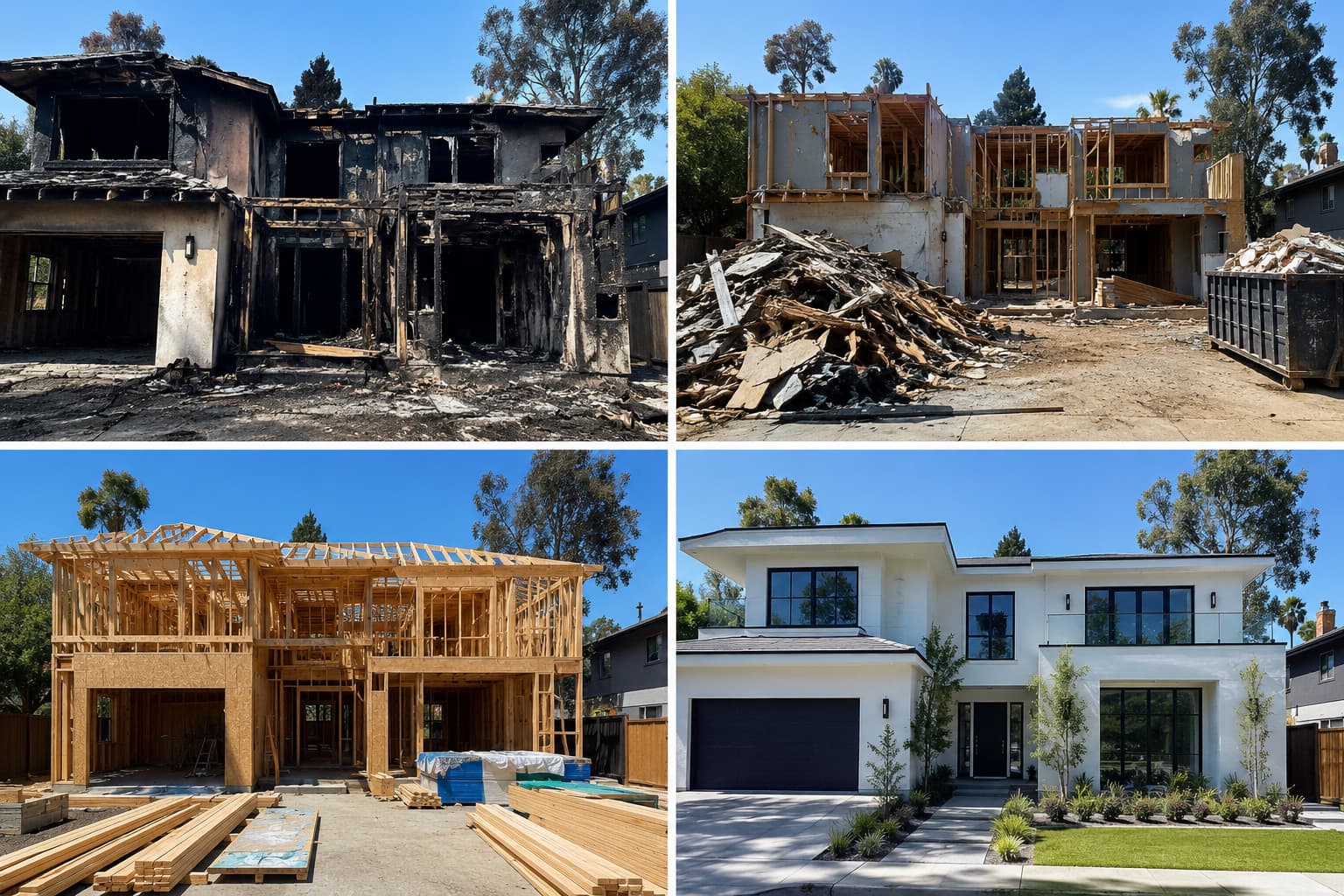
What Happened in Altadena & Pasadena: The Eaton Fire, January 2025
On the evening of January 7, 2025, the Eaton Fire ignited in the hills above Altadena and tore through the communities of Altadena, Pasadena, and Sierra Madre with catastrophic speed. By the time full containment was declared on January 31 — 24 days later — the fire had consumed 14,021 acres, destroyed 9,414 structures (residential, commercial, and other), damaged 1,074 additional structures, and tragically claimed 19 lives, according to the LA County official one-year fact sheet citing CAL FIRE final incident data (published December 2025, modified January 2026). The Eaton Fire is the second most destructive wildfire in California history, displacing over 20,000 people and impacting an estimated 6,800 businesses and 47,000 workers across the burn zone.
The destruction fell disproportionately on Altadena, an unincorporated community of roughly 42,000 residents in the foothills of the San Gabriel Mountains, where entire neighborhoods were reduced to ash in a matter of hours. Because Altadena is unincorporated Los Angeles County — not part of the City of Pasadena — every permit, every fee waiver, and every rebuild rule flows through a different government authority than what neighboring Pasadena homeowners navigate. This distinction is the single most important thing an Eaton Fire survivor needs to understand before starting their rebuild journey.
In the 18 months since the fire, the physical recovery has moved faster than any wildfire rebuild mission in American history. The US Army Corps of Engineers completed Phase 2 structural debris removal in August 2025 — clearing more than 5,600 private properties and removing over 1.4 million tons of debris in approximately six months, far ahead of the initial 18-month estimate. Utility infrastructure has been restored, Southern California Edison has launched an undergrounding plan for 153 circuit miles across Altadena and Malibu, and every county rebuild program is fully operational. The ground is ready. The bottleneck is no longer the government — it is the speed and quality of design and permitting on the homeowner side.
This guide is the definitive resource for homeowners rebuilding in the Eaton Fire zone. It covers every major step — from permit pathways to building codes to insurance strategy — using exclusively verified data from CAL FIRE, LA County, the California Department of Insurance, and shovels.ai permit records, all sourced as of July 2026. Goldenline Construction (CSLB License #989378), a Los Angeles design-build general contractor, has prepared this guide as a public service. We are a full design-and-build firm: one team for architecture, engineering, permits, insurance documentation support, demolition, construction, and finishes. Explore our fire rebuild services or view our dedicated Altadena and Pasadena rebuild pages for location-specific guidance.
Where the Rebuild Stands Now: 18-Month Progress Report
As of July 7, 2026 — the 18-month mark since the fire — 100 homes have been fully rebuilt in the Eaton Fire burn zone, 1,796 homes are under active construction, and 2,981 building permits have been issued, representing approximately 1% of the destroyed housing stock per the LA County rebuild dashboard (reported by CBS Los Angeles, July 7, 2026).
Those numbers demand honest context. One percent rebuilt after a year and a half sounds discouraging — and for the 66% of survivors who remain displaced (per a Department of Angels survey cited in the same CBS report), it is discouraging. But the pipeline tells a different story: 1,796 homes under construction means the pace of completions will accelerate substantially over the next 6–12 months. The earliest adopters — those who filed complete permit applications immediately after debris clearance — began moving back in by late 2025.
The First Rebuild: Proof It Can Be Done
The very first fully rebuilt home in the Altadena Eaton Fire burn zone received its certificate of occupancy on December 4, 2025 — a 2,160-square-foot, three-bedroom, two-bath home on East Loma Alta Drive rebuilt in just four months (ABC7, December 4, 2025). The homeowner, Ted Koerner, credited a streamlined process and a committed contractor for the rapid turnaround. This rebuild proves that fast timelines are possible in Altadena — but only when every part of the process goes right.
The Permit Bottleneck: 32 Days County, 122 Days Applicant
The median time to obtain a building permit in Altadena reached 155 days as of March 2026 — up from 127 days in December 2025, and rising, not falling. Here is the critical detail that most coverage misses: only 32 of those 155 days are spent in actual county review. The remaining approximately 122 days are delays caused by incomplete submissions and slow applicant-side responses — architects revising plans, engineers updating calculations, and homeowners waiting on decisions (Los Angeles Times, April 2026). The county has committed to a 10-business-day turnaround on first plan reviews and 5 business days on subsequent reviews for Public Works, Fire Department, and Public Health (LA County Recovery). The math is stark: the fastest thing in the Altadena rebuild equation is the government.
The Permit Pathway: LA County vs. City of Pasadena
If your property is in Altadena, you are in unincorporated Los Angeles County — and every permit, fee waiver, and rebuild rule runs through LA County Public Works and Regional Planning, not the City of Pasadena. The County's programs are distinct from LA City's Palisades programs and from what Pasadena homeowners navigate. Understanding this jurisdictional split before you hire an architect or contractor saves months of confusion.
The Altadena One-Stop Permit Center
The physical hub for Eaton Fire rebuilds is the Altadena One-Stop Permit Center at 464 W Woodbury Road, Suite 210, Altadena, CA 91001 (phone: 626-424-6743). Walk-in hours are Monday through Friday, 8:00 AM to 4:30 PM, with the last call for permits at 3:00 PM. Six agencies are co-located under one roof: LA County Public Works, Regional Planning, Public Health, the Fire Department, SoCalGas, and Southern California Edison (LA County Recovery, July 2026).
For digital submissions, the County operates the EPIC-LA online permitting portal, which handles plan submittals, permit applications, and status tracking. Most homeowners will use a combination of in-person visits to the One-Stop Center for initial guidance and EPIC-LA for digital document uploads throughout the process.
Like-for-Like Rebuild: The 10%-or-200-Square-Foot Rule
The Eaton Fire area benefits from the most generous like-for-like provision of any LA County fire zone. Homeowners rebuilding in the Eaton burn area may increase floor area, size, height, or building footprint by up to 10% or 200 square feet, whichever is greater — a meaningfully more generous allowance than LA City's straight 10% rule for Palisades rebuilds (LA County Recovery, July 2026). Like-for-like rebuilds do not need to comply with current zoning codes, but they must comply with the current Building Code, Fire Code, and Health & Safety Code. You may also rebuild smaller or with a different floor plan than the original — "like-for-like" refers to purpose, not identical design.
Self-Certification Pilot: Bypass Plan Review
LA County operates a Building Plan Self-Certification Pilot Program that allows licensed architects and civil engineers to certify that residential plans comply with the LA County Building Code, bypassing the traditional county plan review entirely. To qualify, the professional must hold a current California license in good standing, have at least three years of LA County code-compliance experience, and carry professional liability insurance of at least $500,000 per claim and $1,000,000 aggregate. The program covers single-family homes, garages, and ADUs lost or damaged by the Eaton or Palisades fires, located in unincorporated LA County and outside Geologically Sensitive Areas. The County conducts random audits of at least 20% of self-certified submissions (LA County Recovery, July 2026).
This program is tailor-made for design-build firms whose architects are on staff. When the licensed professional certifying the plans is part of the same company that will build the home, the incentive to get every detail right — not merely approved — is built into the business model. Goldenline Construction's design-build structure plugs directly into this pathway.
Fee Refunds: What the County Covers
On June 17, 2025, the LA County Board of Supervisors unanimously approved waiving and refunding permit fees for qualifying owner-occupants rebuilding single-family homes. To qualify, the applicant must have both owned and lived in the property as their primary residence before January 7, 2025. Trusts qualify if the beneficial owner lived there; LLC- and corporate-owned properties do not. Covered fees include zoning review, building plan review, soils and geological review, building permits and inspections, and fire department reviews — including accessory structures such as garages, ADUs, and pools. Temporary standalone ADUs for owners awaiting reconstruction also qualify. There is no application deadline, and refunds are typically processed within two to four weeks. Submit to recovery@planning.lacounty.gov or in person at the One-Stop Permit Center (LA County Recovery, July 2026).
Pending Legislation: SB 1090 and Altadena's SB 9 Suspension
SB 1090, a bill that would temporarily suspend SB 9 (2021) and SB 1123 (2024) ministerial-approval requirements in Altadena ZIP codes 91001 and 91003 for applications filed between January 7, 2025 and January 7, 2030, is pending in the California legislature as of July 2026 (CalMatters, July 2026). This bill is a moving target — its status should be verified before making any property decision that depends on it.
Building Code Requirements for Your Rebuilt Home
Every rebuilt home in the Eaton Fire zone must comply with the current California Building Code, including wildfire-specific hardening provisions that did not exist when most of the destroyed homes were originally built. The code landscape changed significantly on January 1, 2026 — understanding what applies and what is still pending saves you from costly mid-construction corrections.
CWUIC: The Successor to Chapter 7A
Effective January 1, 2026, the building-code provisions for construction in Wildland-Urban Interface (WUI) zones moved from CBC Chapter 7A into the new California Wildland-Urban Interface Code (CWUIC, Title 24 Part 7). Los Angeles County has adopted the CWUIC by reference for buildings in Very High and High Fire Hazard Severity Zones. The operative requirements live in CWUIC Chapter 5 and include:
- Class A fire-rated roof assembly tested to ASTM E108 or UL 790 (§504.2)
- Ember-resistant vents listed by the State Fire Marshal or tested to ASTM E2886, with noncombustible, corrosion-resistant mesh openings of 1/16 inch minimum to 1/8 inch maximum (§504.10)
- Exterior walls constructed of noncombustible material, ignition-resistant labeled material, or fire-retardant-treated wood rated for exterior use (§504.5.2)
- Decking tested to ASTM E2632 or E2726, or constructed of ignition-resistant or noncombustible material (§504.7.3.2)
- Glazing: multilayered glazed panels with tempered glass, glass block, or 20-minute fire-rated glazing (§504.8)
- Enclosed eaves with noncombustible or ignition-resistant material, a one-hour fire-resistance rating, or 2-inch nominal lumber (§504.3)
- Noncombustible gutters with debris prevention measures (§504.4)
Note: the state suspended certain building codes that would have taken effect January 1, 2026 for fire rebuilds, meaning homeowners who built to the 2019 Building Code may use previously approved plans (Governor's Office, November 2025). However, WUI exterior hardening requirements still apply per local enforcement. This is a nuanced area where a design-build team that stays current on code interpretations saves you from a rejected permit submission.
Zone 0: The Ember-Resistant Zone (Pending, Not Yet Law)
Zone 0 — an ember-resistant zone extending 5 feet from the structure, required by AB 3074 (2020) — is not yet current law as of July 2026. The Board of Forestry released an updated draft in April 2026 with a phased approach prioritizing education over immediate enforcement. The draft proposes a three-tier framework: a 1-foot Safety Zone with no plants, a 2-to-5-foot zone restricting plants near windows, vents, doors, and decks, and a broader 5-foot buffer permitting grass and dispersed plants up to 18 inches with trees allowed if trimmed away from walls and the roof. Pending final adoption by the Board of Forestry (draft as of April 2026), Zone 0 is not yet enforceable — but designing to its principles now is a prudent investment in both safety and future compliance.
Defensible Space and Fire Hazard Severity Zones
California Public Resources Code §4291 requires 100 feet of defensible space around structures in wildfire-prone areas, organized into Zone 1 (0 to 30 feet, the "lean, clean, and green" zone requiring the most aggressive vegetation management) and Zone 2 (30 to 100 feet, requiring fuel reduction), plus the pending Zone 0. CAL FIRE issued updated Fire Hazard Severity Zone maps for Los Angeles County on March 24, 2025, and local agencies may increase but not decrease the state-recommended severity level. Los Angeles County Fire Department projects an increase in the number of affected parcels under the new maps.
Insurance Realities for Eaton Fire Rebuilds
Insurance is the financial engine of every rebuild — and the California insurance market has transformed dramatically since the January 2025 fires. Understanding your coverage, the market landscape, and the steps you can take to protect your insurability is as important as getting your permits right.
The FAIR Plan: California's Insurer of Last Resort
The California FAIR Plan, the state's insurer of last resort for properties in high-risk wildfire areas, held 684,388 policies with $750 billion in total exposure as of March 2026 — increases of 152% and 242% respectively since September 2022 (California FAIR Plan key statistics). Following the January 2025 fires, Insurance Commissioner Lara approved a $1 billion member assessment on February 11, 2025 — the first such assessment in over 30 years — to cover approximately 3,621 Palisades claims and 1,369 Eaton claims. If you hold a FAIR Plan policy, it provides basic fire coverage but typically excludes liability, theft, and water damage. Many FAIR Plan policyholders supplement with a "difference in conditions" policy from a traditional carrier.
The Expired Moratorium: What You Need to Know
The SB 824 one-year mandatory non-renewal moratorium for properties affected by the Palisades and Eaton fires ran from January 7, 2025 through January 7, 2026 — it expired over six months ago. As of January 2026, homeowners in the Eaton Fire zone are no longer protected from non-renewal by their insurers (California Department of Insurance). This makes CWUIC-compliant hardening, Safer from Wildfires compliance, and IBHS certification not just safety measures but retention strategies for your insurance coverage.
Safer from Wildfires: Discounts for Hardening
The California Department of Insurance's Safer from Wildfires framework establishes 10 mitigation actions across three layers, each qualifying homeowners for an insurance discount. The structure layer includes five actions: a Class A fire-rated roof, ember- and fire-resistant vents (1/16 to 1/8 inch mesh), noncombustible 6 inches at the base of exterior walls, enclosed eaves, and upgraded multi-paned windows. The immediate surroundings layer includes three actions: a 5-foot ember-resistant zone, cleared vegetation and debris under decks, and combustible outbuildings moved at least 30 feet from the home. The community layer includes defensible space compliance and Firewise USA community participation. Larger wildfire mitigation discounts took effect July 1, 2026 under the state's Sustainable Insurance Strategy. Every action under Safer from Wildfires qualifies for a discount (California Department of Insurance).
Goldenline Construction integrates these hardening measures into every fire rebuild project we design — not as optional upgrades, but as standard practice that lowers your long-term insurance costs.
IBHS Wildfire Prepared Home Certification
The Insurance Institute for Business & Home Safety (IBHS) offers Wildfire Prepared Home certification with two tiers, renamed as of June 9, 2026: Essential (formerly Base) and Enhanced (formerly Plus, which adds radiant heat and direct flame contact protection). The application fee is $125, certification is valid for three years, and — critically — all required actions must be completed before certification is granted; partial mitigation does not qualify. Discounts are not guaranteed and vary by insurer (IBHS, June 2026).
What Rebuilding Costs in Altadena & Pasadena
No honest contractor publishes a per-square-foot rebuild cost — every circulating range is competitor marketing disconnected from your specific lot, soil, slope, finish selections, and building-code era. What public permit-value data tells us: in the 13 months after the fires, Altadena logged $2.78 billion in total permitted job value — an 18-fold increase over the pre-fire annual average of $156 million. The average building permit job value rose from $67,000 pre-fire to $275,000 across the Eaton corridor, with the broader corridor crossing $3.15 billion in total permitted value. Across both the Palisades and Eaton fire zones, 6,932 new residential construction permits were issued in the year after the fires versus just 194 in all of 2024 — a 35-fold increase (shovels.ai, March 2026).
Your specific cost depends on lot conditions and accessibility, demolition and debris removal status, structural engineering requirements, the CWUIC exterior hardening package, utility connections and any required undergrounding, finish selections, and prevailing-wage labor availability. Design-build controls cost most effectively because design decisions and construction costs are visible together from day one — rather than receiving a price shock after the architect finishes and the bids come in.
Property Tax: What Rebuilding Means for Your Assessment
If you rebuild "in a comparable manner" to your destroyed home, you preserve your Proposition 13 base-year assessed value. Additions beyond comparable — such as an extra bathroom, a larger footprint beyond the like-for-like allowance, or an ADU — are assessed at full market value (California Board of Equalization). Under Proposition 50, if your damage exceeds 50% of the full cash value, the replacement is capped at 120% of the destroyed property's value before any excess is assessed, within a five-year window. A disciplined design-build scope has permanent property-tax value: build what you need, not more than your insurance and budget support.
Realistic Timeline Expectations for Eaton Fire Rebuilds
Timeline expectations should be grounded in data, not optimism. The fastest rebuild demonstrates what is possible when everything goes right; the median data shows what homeowners should actually plan for.
Fastest Case: 4 Months
The first fully rebuilt Altadena home — 2,160 square feet, three bedrooms, two bathrooms on East Loma Alta Drive — received its certificate of occupancy on December 4, 2025, just four months after construction began. The first rebuild permit in Altadena was issued even earlier, on April 11, 2025, to San Gabriel Valley Habitat for Humanity on North Olive Avenue, roughly three months post-fire. These cases prove that rapid timelines are achievable in the Eaton zone when a property is straightforward, the permit package is complete, and the contractor is prepared.
Typical Case: Plan for 12–18 Months
- Median permit time reached 155 days (~5 months) as of March 2026 — and was rising, not falling (Los Angeles Times). Only 32 of those days are county review; approximately 122 days are applicant-side design delays.
- County commitment: 10 business days for first plan review, 5 business days for subsequent reviews on Public Works, Fire Department, and Public Health submissions.
- Construction duration for a typical single-family home in the Eaton zone ranges from 6 to 14 months, depending on size, site complexity, customization, and weather.
- Across both LA fire zones, roughly 20% of destroyed homes were permitted one year post-fire — faster than Maui (2%), Paradise (3%), and Redding (15%), but slower than Boulder (30%) (CalMatters, January 2026).
The single biggest variable you control: whether your permit package is complete and code-current on first submission. In Altadena, 122 days of delay are created by design-side back-and-forth, not by the county. A design-build team that submits a complete, jurisdiction-specific package eliminates those months from your timeline.
Why Design-Build Is the Smartest Choice for Eaton Fire Rebuilds
In a traditional design-bid-build model, you hire an architect, wait for plans, put the plans out to bid, select the lowest contractor, and then discover — often months into construction — that the design exceeds your insurance proceeds or will take longer than your Additional Living Expenses coverage lasts. Each handoff between separate firms introduces delay, miscommunication, and cost escalation. For Eaton Fire rebuilds, where 122 days of the median 155-day permit timeline are created by design-side back-and-forth, this fragmented approach is the single biggest risk a homeowner can take.
Design-build eliminates the handoffs. One firm holds the design, the budget, the permit strategy, and the construction schedule from the first meeting. Your architect, engineer, and builder sit in the same room — or are part of the same company. Code compliance, including CWUIC Chapter 5 hardening, defensible space planning, and jurisdiction-specific like-for-like rules, is baked into the drawings from the start rather than caught in a plan-check comment six weeks later. The self-certification pathway — available in LA County for licensed architects and engineers — is a natural fit for a design-build firm whose licensed professionals are on staff.
Goldenline Construction is that firm. CSLB License #989378. One company for architecture and design coordination, structural engineering, insurance documentation support, permit strategy across LA County and all LA-area jurisdictions, demolition, construction, and finishes. We do not subcontract your design to an outside architect or your permits to a third-party expediter — one team, one point of accountability, from the first site visit through the final walkthrough.
See our fire rebuild services, our dedicated Pasadena & Altadena home rebuilding page, and our Altadena remodeling contractor page for more location-specific information.
Start Your Altadena or Pasadena Rebuild Today
Rebuilding after the Eaton Fire is not just a construction project — it is the process of reclaiming your home, your neighborhood, and your daily life after an unimaginable loss. The right contractor understands this. At Goldenline Construction, we have built our fire rebuild process around the reality that you are recovering from trauma while simultaneously making hundreds of design, budget, and schedule decisions. We start every rebuild with a free, no-obligation consultation at your property.
During that consultation, we walk the site with you, assess your insurance coverage, identify the exact county permit pathway that applies to your property (including fee-refund eligibility and self-certification opportunities), and outline a realistic timeline and budget based on your specific lot, scope, and finish expectations — not a generic square-footage multiplier. We explain exactly how the CWUIC requirements, defensible space rules, and like-for-like provisions apply to your specific rebuild.
Call us at 818-724-8494, visit our headquarters at 6449 Independence Avenue, Woodland Hills, CA 91367, or contact us online. The ground is ready. The debris is cleared. The county programs are live and the fee refunds are processing. The biggest variable left in your rebuild timeline is the team you hire. Start the conversation today.